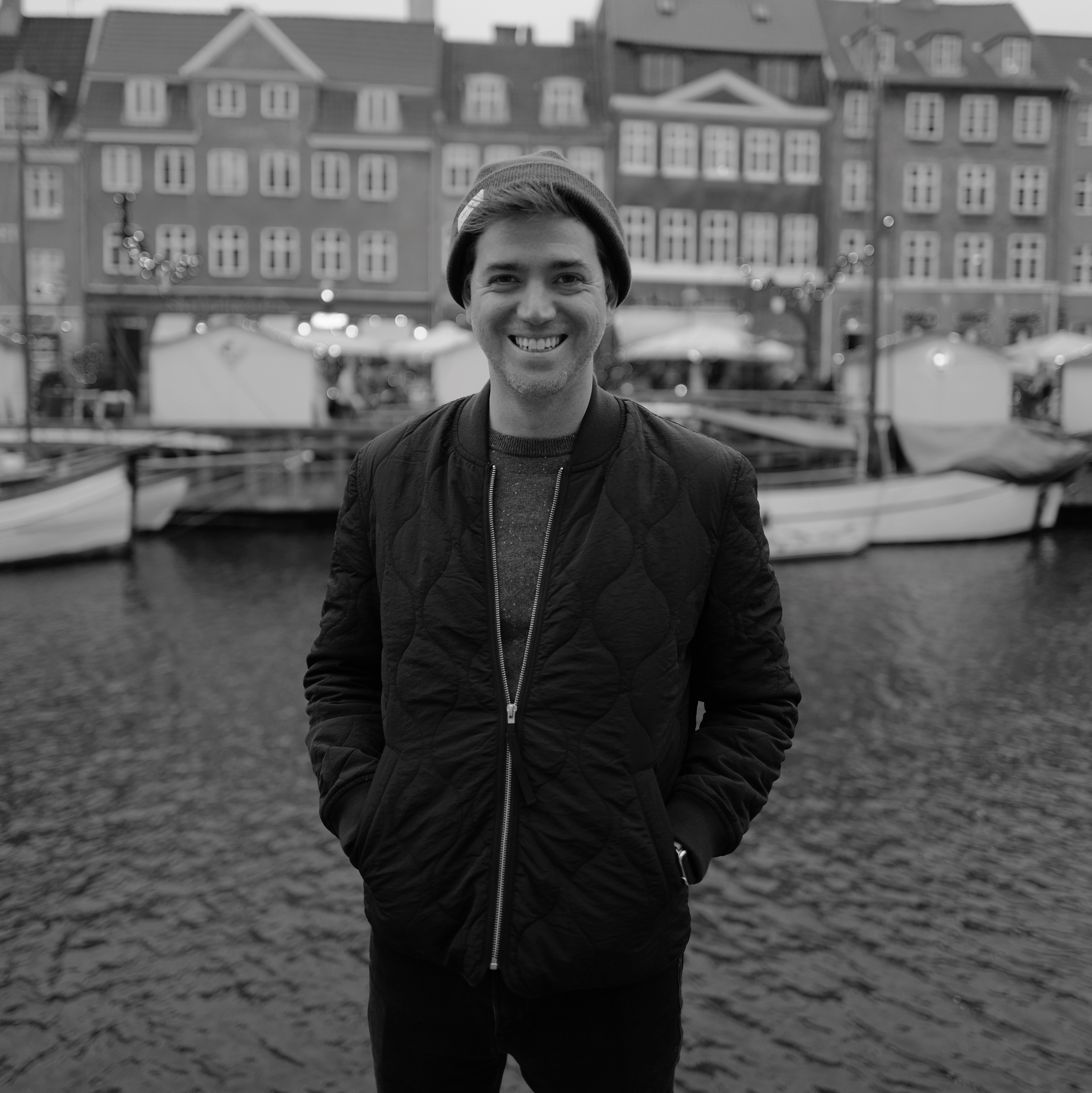
Brandon McGraw
I'm Brandon McGraw: creator of Landmarks for iPhone, technology enthusiast & marketing professional with experience managing global advertising campaigns for Apple & Lenovo.
Just backed my first-ever Kickstarter campaign: Ghost a blogging platform. Look forward to seeing John and team bring this to life, it’s beautiful, simple and just what I’m hoping for as a future blogging tool.
Take a look and support if you’re interested. They’ve reached their funding goal, but if they reach their stretch goal everyone is granted a free hosted account for a year.
I’ve been reading reviews, watching video and have been keeping up with the regular lot of tech pundits as they’ve dissected Glass since Google announced it. Each new bit of info reinforces a central point that is stuck in my head— as such, I thought I’d add it to the stack of commentary.
I believe Glass is a prime example of a technology that’s coming too soon. It fails to acknowledge the world it’s being birthed into and has no killer app that will drive us to change our behavior overnight.
We will remember Glass tomorrow the same way we remember Windows CE & Pocket PC today: as getting there first but totally missing the point.
Glass comes at a time when we’re still grappling with how much technology is too much and when questions about online privacy are at a fever pitch. It answers neither of these. What’s worse, it exacerbates both conversations by bringing in even more technology and newer concerns about privacy.
Glass is an interesting and impressive piece of technology and wearable computing will happen. But when it happens right, the questions will have been answered by society or someone will have cracked the killer app that makes us want to change society to suit it.
Two great stories on Space and exploration this week.
First is from Vice Magazine who profiled the founders of Copenhagen Suborbitals a homemade, open-source take on building a suborbital space shuttle using off-the-shelf products.
“If we wanted to fly into space, we could either try to become astronauts…It is probably not going to happen. You could also wait until maybe Virgin Galactic finishes their project. That’s going to take a long time. But wouldn’t it be much more fun if you just created your own spacecraft yourself, your own space rocket, [and] fly into space doing that?”
- Kristian Von Bengtson, Co-founder Copenhagen Suborbitals
Second is a team of international astronomers announcing the discovery of a planetary system around the star Tau Ceti, which at 12 light years away is still visible to the naked eye in the evening sky.
“This discovery is in keeping with our emerging view that virtually every star has planets, and that the galaxy must have many such potentially habitable Earth-sized planets.”
- Steve Vogt, professor of astronomy and astrophysics, UC Santa Cruz
Great to see the collaborative innovation that came first to the web and now to physical products extend into the realm of technology for exploration. These homemade developments, coupled with the promise of more to explore should inspire us all to dream even bigger in the years ahead.
Maybe it’s a result of my childhood desire to be an astronaut, but I’ve always been mystified by space exploration. I was worried that national disinterest in NASA would let a generation go by without the promise of being able to touch the stars. I’m glad to see that’s not the case.
3D printing is the teleportation we always imagined (for objects, at least). We’re not fully there yet, but this is a clear step towards that direction.
“3D-printed consumer electronics just became a reality”
Embedding sensors and electronics inside of 3D objects in a single build process has been a long sought after goal in 3D printing (3DP). A group led by Simon Leigh, at the University of Warwick in England, has now done just that. Leigh’s group developed a low-cost material they call carbomorph – a carbon black filler in a matrix of a biodegradable polyester.
Whoever comes up with the App Store model - a reliable store for consumers and a profitable distribution center for creators - for physical things stands to reap incredible awards when this technology takes off.
I’m an active reader of Marco’s blog over at marco.org, Instapaper is in my top five most used apps list, and I’ve even given a listen to a few streams of Build and Analyze. Suffice it to say, I’m a fan of Marco’s work.
His latest project, The Magazine, is an experiment on what an iPhone & iPad native magazine should feel like. The content is tailored to what an individual passionate about technology would like to read, rather than just being about technology itself. Most importantly, it features what is fast becoming his trademark — an unshakable focus on clear, clean design that puts reading and the reader first.
Here it is in Marco’s own words:
The Magazine is for people who love technology, especially the internet, mobile, truly great personal computers, and related fields influenced by technology such as photography, publishing, music, and even coffee.
Rather than telling readers everything that happens in technology, we deliver meaningful editorial and big-picture articles.
The Magazine publishes an issue every two weeks, usually with four medium-length articles.
Subscriptions are $1.99 per month with a free 7-day trial. And all subscriptions, even during the free trial, include access to all back issues. Start your free trial today and browse as much as you’d like.
The Magazine, to me, represents the seed of what I’ve seen emerging in this latest evolution of digital content on the web. A return to quality content, backed by the support of readers not page views, that’s using mobile technology to deliver a depth of experience that print couldn’t offer with the intimacy between reader and content that the desktop web couldn’t capture.
If you believe in the future of content distribution, I urge you to try The Magazine. At $1.99 per month you’ll be supporting great ideas delivered every two weeks in an intimate, elegant fashion.
Say what you will about the execution — I happen to think it’s a little too heavy on the heartstrings — but make no mistake, this is about what’s next for Facebook.
It abstracts Facebook into a connector of humanity and human information, making it bigger than just a tool for connecting with Friends.
The rumor is that Facebook will get into search — this is the start of setting the foundation needed to launch that platform.
Absolute truth. This is something that’s so clearly missing in most places where process and niceties literally squeeze greatness out of an idea.
“Even though he treated people like this, the reason he got such great people to work there, unlike most bosses, is that he appreciated great work. There are two components to giving employees great feedback. It takes someone who has the taste to know when you did great or lousy, and it takes someone who’s blunt enough to tell you. There are plenty of people who don’t have taste but are blunt.
If you wanted to do great work, you can do it at Apple. But there’s a cost–public humiliation. Something like this could never have happened at HP. It’s contrary to the HP way. On the other hand, you couldn’t do your best work at HP because there is no one there to appreciate it. Where would you rather work–Apple or HP?”
Back in July, Woz did a Q&A on the comments section of Gizmodo. I wasn’t able to post my favorite selection back then, but when cleaning out my inbox this weekend, I rediscovered it. Brilliant thoughts from the man who started it all.
I’ve also read iWoz and highly recommend it to anyone who wants more brilliance.
Change the world because you want to. Don’t judge it by money success. Don’t expect success from the start. Go as far as you can making it perfect before you share it or seek funding. Have a working model or demonstration before you seek venture money. You could get funded and spend $100K on a video demonstration and then own less of your company and need further funding sooner. Or you could work hard to make a video for free, in your home (garage), and be that much better at the deal you finally work. And expect that many of your first tries will go nowhere. But they will get you experience toward the big one. You should have a job or live at home so you can work on your own passions on your on time. That implies not being too social or partying. Make good things when you are young and you’ve covered your needs for life.
This is a book I will immediately be picking up. Fascinating glance inside YC and more great wisdom from Graham.
Graham tells the Kalvins, “Here’s how to generate new ideas. Three things. One: founders are target users. Two: not many people could build it, but founders are among them. Three: few people realize it is a big deal.”
I’m excited to announce that after becoming a paid app a few short months ago, Landmarks has now sold over 100 copies. A sizable boost has come from last week’s release of Landmarks 2.0.
For a guy that just wanted to make it easy to learn more about the buildings all around us, I couldn’t be more pleased.
Thanks for exploring New York City with Landmarks.
Like many other folks, I started 2012 with a list of goals. I made a list of ten and so far, I’m doing pretty well.
At the top of the list was shipping Landmarks 1.0, and 126 days ago back in May I did just that.
Even at the time, I knew it had faults. The database of Manhattan landmarks was behind by a few months, less than 50% of the buildings had an architect, style & full summary.
But it needed to be released, I had been working on it on the side for months and it had reached the point where I started doubting whether anyone would even care when I finally released it. Plus, I’d gone to a few Meetups around the city where everyone was preaching the ‘release, learn, improve & release again’ model. I was torn about releasing an imperfect product. Perfection and polish was the major lesson of my time working with Apple at Media Arts Lab and releasing v1.0 felt far from the polish I’d expected of myself.
In the end, I figured it couldn’t hurt if I offered it for free while I finished it up. This would let me gut check that people would care while I used that momentum to wrap it up.
I packaged it up, submitted it to Apple and did want any sensible person who was releasing an early version of their first App would do, I started a Twitter account: @landmarksapp to “spread the word” and update on approval process.
On May 6, the App hit the store and I was shocked. Week 1, 163 people had downloaded the App. Week 2, 218 more downloaded it. Downloads were coming in from all over the world. In fact, by the time I released Landmarks 1.1 — 35 days after 1.0 — over 570 people from 54 countries had downloaded Landmarks 1.0
I was beyond delighted. The buzz from watching the download count rise energized me to release 1.1, which would improve 1.0 by bringing the landmarks database up-to-date with over 850 total buildings. It also brought building details to nearly 60% of all of the detail pages. Energized from the positive reception and confident that I’d improved the product enough (though not perfected it!) I felt it was time to begin charging for it.
1.1 hit the store and the switch was flipped to paid. Downloads, of course, were no longer anywhere near of the free days. That said, I’ve been consistently delighted with the steady stream of new users who have used Landmarks to explore the City.
I took a short break, and still having much to learn, starting checking out courses on code academy & iTunes U to learn more of the programming fundamentals I’d neglected in my eagerness to get started on a real project. I used Landmarks as I walked about and became increasingly frustrated with the lack of summaries. After all, this is why I created the app in the first place, I wanted to be able to find the answer to “I wonder what that was built for” with just a tap. Only 42% of the summaries were missing, which didn’t sound like a lot, but for some reason those 42% were the only buildings I saw.
It was time to get back to work. Having had the time to separate myself from the product a bit, I realized there were a few other things that needed a fundamental rebuilding. See, Landmarks is part App and part quick and dirty database I built based off of the publicly available NYC Landmarks Preservation Commission data. This quick and dirty database was, as it turned out, pretty dirty. Lots of old information and tacked on formulas. Same with the App. As I was learning, I’d try a few different ways at nearly everything. The remnants of this littered the code with mess. So, I re-wrote them both (keep in mind still that neither is perfect!). App performance increased a bit and I started working on an updated UI design that would put the map more front and center. I also gave the App Icon and detail pages a much needed facelift.
The database had originally been written to keep track of all of the listings. Once I had completed that, I started work on the summaries. As such, it was poorly optimized for the kind of tedious data entry that was going to be required to bring summaries to all 857 buildings. So, when I re-wrote it, I organized it for speed and then got to work.
I alternated between updating the UI and adding the detail pages in 25 building batches. Despite being faster, the process was still tedious beyond imagination, particularly because I did this in the evening hours when I was home and away from my regularly taxing work.
Then, it all started clicking. A few late, late nights in a row and it was done. Just over 90 days after the release of v1.1, 2.0 is here.
2.0 is the single biggest release of Landmarks to-date. I can firmly say that this is the App I always wanted it to be. All of the summaries are included, so you finally have the building’s history in the palm of your hand with just a tap. All of the latest Manhattan landmarks are included, so there’s tons to explore. The App is more beautiful than ever, putting that map of landmarks front and center with less distraction.
I’m excited to share it with the world and hope that it encourages us all, locals and visitors, to stop and appreciate the beautiful architecture of New York City hidden around us in plain sight.
More than anything, I’m just excited to have the product I’ve always wanted to use. I can’t stress enough, build things for yourself — things that you want that either don’t exist or aren’t good enough — it will help you keep the faith when it takes longer than you expected to make it happen.
“We’re keenly aware that when we develop and make something and bring it to market that it really does speak to a set of values. And what preoccupies us is that sense of care, and what our products will not speak to is a schedule, what our products will not speak to is trying to respond to some corporate or competitive agenda. We’re very genuinely designing the best products that we can for people.” - Jonathan Ive
This is the kind of technology that could easily change the world. Safely generated electricity through applying pressure is genius and full of potential. I can just imagine this as a layer of the ground in a place like Times Square, imagine converting all of that foot traffic into electricity.
Berkeley Lab Scientists Generate Electricity From Viruses
New approach is a promising first step toward the development of tiny devices that harvest electrical energy from everyday tasks